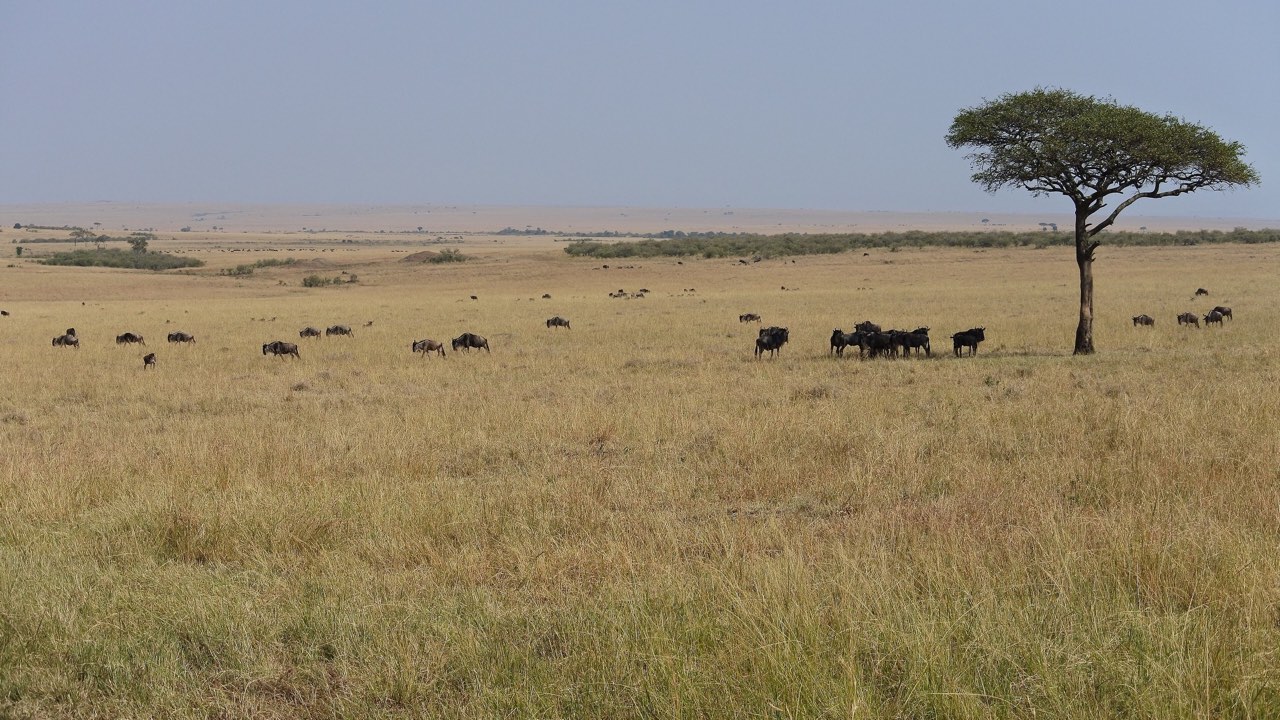
NyumbuThe wildebeest of Masai Mara, Kenya
Masai Mara migration: when the herds are there
The Masai Mara migration, the wildebeest herds' stay in Masai Mara, Kenya, is a likelihood you can read off the record. Large herds were in the Mara in August in 26 of 26 seasons and in September in 25 of 25 seasons, against 19 of 24 seasons for July and 20 of 26 seasons for October, in the Mara Conservancy's monthly reports since 2001. A river crossing cannot be booked for a day: from 2001 to 2015 they happened on 52 days a year on average (plus or minus 16) on the Kenyan Mara River, and in 2025 on about 14 days on the Narok side.
Photo: flightlog / Wikimedia Commons, CC BY 2.0

Some links on this page are affiliate links: the guide earns a commission when you book through them. The partner sets the price; the guide adds no fee.
So pick August or September if the herds are the point of the trip, and give yourself several days in the Mara rather than one. July and October are good odds, not sure ones: in 3 of 25 seasons (2017, 2022 and 2023) the large herds had already left before October began. For rain, fees and the rest of the year month by month, see the best time to visit the Masai Mara.
19 of 24 seasonsJuly, large herds recorded
26 of 26 seasonsAugust
25 of 25 seasonsSeptember
20 of 26 seasonsOctober
MsimuThe record since 2001
The migration season by season
Each row is one season in the Mara. A red bar means large herds were recorded that month; the marks show when the first small groups came, when the first large herds came, when the first crossing of the Mara River was seen and when the large herds left. Tap a month to read its count. Look at the recent rows: the seasons that ended in September are 2017, 2022 and 2023.
The migration in the Mara, season by season, 2001 to 2026. Pick a month.
- 2001: first groups: no report; first large herds: date not recorded; first crossing October; left November.
- 2002: first groups July; first large herds August; first crossing August; left November.
- 2003: first groups July; first large herds July; first crossing August; left January (next year).
- 2004: first groups July; first large herds July; first crossing July; left November.
- 2005: first groups July; first large herds July; first crossing July; left January (next year).
- 2006: first groups June; first large herds July; first crossing July; left November.
- 2007: first groups July; first large herds August; first crossing July; left December.
- 2008: first groups July; first large herds July; first crossing July; left November.
- 2009: first groups June; first large herds July; first crossing July; left November.
- 2010: first groups June; first large herds June; first crossing June; left November.
- 2011: first groups June; first large herds July; first crossing July; left November.
- 2012: first groups July; first large herds August; first crossing July; left November.
- 2013: first groups June; first large herds June; first crossing July; left December.
- 2014: first groups May; first large herds June; first crossing June; left October.
- 2015: first groups July; first large herds August; first crossing August; left November.
- 2016: first groups June; first large herds June; first crossing June; left December.
- 2017: first groups June; first large herds June; first crossing June; left September.
- 2018: first groups July; first large herds July; first crossing August; left December.
- 2019: first groups May; first large herds June; first crossing July; left October.
- 2020: first groups July; first large herds July; first crossing July; left October.
- 2021: first groups June; first large herds July; first crossing August; left October.
- 2022: first groups June; first large herds July; first crossing July; left September.
- 2023: first groups July; first large herds August; first crossing July; left September.
- 2024: first groups July; first large herds July; first crossing July; left October.
- 2025: first groups July; first large herds July; first crossing July; left November.
- 2026: first groups June; first large herds: date not recorded; first crossing: season not yet reported; left: season not yet reported (reports up to October).
June
6 of 24 seasons with large herds recorded in the Mara
Large herds in June: 2010, 2013, 2014, 2016, 2017 and 2019.
July
19 of 24 seasons with large herds recorded in the Mara
Seasons without large herds in July: 2002, 2007, 2012, 2015 and 2023.
August
26 of 26 seasons with large herds recorded in the Mara
Seasons without large herds in August: none.
September
25 of 25 seasons with large herds recorded in the Mara
Seasons without large herds in September: none.
October
20 of 26 seasons with large herds recorded in the Mara
Seasons without large herds in October: 2001, 2013, 2016, 2017, 2022 and 2023. The large herds had already left before October began in 3 of 25 seasons (2017, 2022 and 2023).
November
13 of 25 seasons with large herds recorded in the Mara
Seasons without large herds in November: 2001, 2011, 2014, 2015, 2017, 2019, 2020, 2021, 2022, 2023, 2024 and 2025. The large herds had already left before November began in 8 of 25 seasons (2014, 2017, 2019, 2020, 2021, 2022, 2023 and 2024).
December
4 of 24 seasons with large herds recorded in the Mara
Large herds in December: 2003, 2005, 2007 and 2013. The large herds had already left before December began in 19 of 25 seasons.
January
2 of 25 seasons with large herds still in the Mara into January
They left during January in 2003 and 2005. In 23 of 25 seasons the large herds had gone before January began.
- Large herds recorded in the month
- Wildebeest recorded, no large herds
- No wildebeest recorded
- No report covers the month
- First small groups
- First large herds
- First Mara River crossing
- Large herds left
"First large herds" means the first large herds recorded in the Mara, on either side of the river; "first crossing" means the first wildebeest crossing of the Mara River recorded inside the Mara; "left" is the month the report says the large herds left the Mara for the season. Source: the Mara Conservancy monthly reports, read season by season. Seasons without a report for a month show a gap, not a guess. The latest season is still open: it runs to the most recent report, October2026.
The same record as a table, month by month
| Month | Large herds recorded | Seasons without large herds | Large herds left during the month | Already gone before the month |
|---|---|---|---|---|
| June | 6 of 24 seasons | 2002, 2003, 2005, 2006, 2007, 2008, 2009, 2011, 2012, 2015, 2018, 2020, 2021, 2022, 2023, 2024, 2025 and 2026 | none | none |
| July | 19 of 24 seasons | 2002, 2007, 2012, 2015 and 2023 | 0 of 25 seasons | 0 of 25 seasons |
| August | 26 of 26 seasons | none | 0 of 25 seasons | 0 of 25 seasons |
| September | 25 of 25 seasons | none | 3 of 25 seasons | 0 of 25 seasons |
| October | 20 of 26 seasons | 2001, 2013, 2016, 2017, 2022 and 2023 | 5 of 25 seasons | 3 of 25 seasons |
| November | 13 of 25 seasons | 2001, 2011, 2014, 2015, 2017, 2019, 2020, 2021, 2022, 2023, 2024 and 2025 | 11 of 25 seasons | 8 of 25 seasons |
| December | 4 of 24 seasons | 2002, 2004, 2006, 2008, 2009, 2010, 2011, 2012, 2014, 2015, 2016, 2017, 2018, 2019, 2020, 2021, 2022, 2023, 2024 and 2025 | 4 of 25 seasons | 19 of 25 seasons |
| January | 2 of 25 seasons, leaving that month | not counted | 2 of 25 seasons | 23 of 25 seasons |
PundamiliaThe first animals in
When the first herds come
The first large herds of a season were recorded in June in 6 of 24 seasons, in July in 13 of 24 seasons and in August in 5 of 24 seasons. The range runs from early June (2014) to late August (2015). Small advance groups come earlier, from 27 May (2014) to 30 July (2005), on either side of the river. In 2025 the Mara Triangle kept the herds longest: they came in good numbers and stayed at least three months.
The zebra you meet before the wildebeest are not always the vanguard of the same migration. The Mara Conservancy notes that the zebra that come a few days ahead of the main herds are a separate population, moving between the Loita plains and the reserve. The migration from the Serengeti in Tanzania carries an estimated 175,000 zebra alongside the wildebeest, according to a 2017 study.
There is a second, smaller wildebeest population too. The resident Loita wildebeest have declined and now stay in the conservancies outside the reserve, so a conservancy camp can show wildebeest outside the migration months. The migration itself mostly does not reach them: Mara Naboisho Conservancy states that the Great Migration does not pass through Naboisho and moves mainly through the reserve. If herds are the goal, sleep in or beside the reserve; where to stay and the conservancies page set out the choice.
August: which side of the river
Recent seasons split unevenly. In 2025 the herds stayed on the Narok side only about a month, while in the Mara Triangle they came in good numbers and stayed at least three months, the Mara Conservancy's review of the year says. One season does not set the next, but if August is your month, weigh a base that reaches the Mara Triangle as well as the Narok side; where to stay lines up the bases by side.


Zebra and wildebeest graze together; the zebra that arrive first may be the Loita population, not the migration.
Booking a trip for the migration months
The three trips below run three or four days from Nairobi. In the migration months the park fee is the high-season one: USD 200 per non-resident adult per day from 1 July to 31 December, valid 6:00 to 18:00 on its day. Check whether a listing includes it.
Group, by road
Three-day, two-night group safari in a 4WD jeep
GetYourGuide, run by Perfect Wilderness Tours and Safari.
from USD 199 per person, listed 12 November 2026; park fees excluded
Private, lodge
Three-day private safari with a lodge
Viator, run by Explorer Kenya Tours and Travel.
from USD 1,255 per person, listed 12 November 2026; park fees included
Small group, with Lake Nakuru
Four-day Kenya safari: the Mara and Lake Nakuru
TourRadar, run by Africa Venture Safaris.
from USD 960 per person, listed 12 November 2026; park fees excluded
More trips by length, style and month, with the park fees added: the trip finder. What a whole safari costs: Masai Mara safari cost. Getting there: Nairobi to Masai Mara.
Mto MaraThe Mara River
The odds of a river crossing
No one can schedule a crossing. The Mara Conservancy calls crossings frequent but hard to predict; its sign to watch for is a mass of agitated wildebeest bunching on the bank.
The first crossing of a season was recorded in June in 4 of 25 seasons, in July in 15 of 25 seasons and in August in 5 of 25 seasons, with a range from June (2010) to October (2001). After that, crossings come and go with the herds, back and forth across the river.
What has changed is how many crossing days the Narok side gets. A 2017 study counted 52 crossing days a year on average (plus or minus 16) on the Kenyan Mara River in 2001 to 2015. The Mara Conservancy's review of 2025 gives the Narok side about 14 crossing days, down from 29 in 2024 and 50 in the past, while in the Triangle the herds came in good numbers and stayed at least three months.
The practical reading: plan on several days near the river, ask your camp where the herds were last seen, and do not judge a trip by whether it shows a crossing.
The study counted the whole Kenyan stretch of the river; the 2024 and 2025 figures are the Narok side only, so the bars show a direction, not one series.


RamaniCrossing points
Where the herds cross, and where they no longer can
- 1Serena. In May 2024 the Mara Conservancy reported no crossings at the main crossing above Serena for four years. The reserve management plan proposes a viewing platform on the Triangle side of the Serena Crossing, a proposal, not a built thing.
- 2Talek River. The same report says the wildebeest have no places left to cross the Talek.
- 3Sand River. The reports record herds crossing the Sand River into the Narok side near Roan Hill (2003, 2010) and near Keekorok (2012). The Mara Conservancy's January 2026 report says camps along the Sand River had blocked a major crossing point.
A 2017 study counted 12 major crossing sites on the Kenyan part of the Mara River. Which ones the herds use shifts with the river and with what stands on its banks. The Mara Conservancy reports that wildebeest avoid human habitation completely within 2 km (1.2 mi) and up to 5 km, and that over 80% of Kenyan camps stand along rivers, while Tanzania allows none there. Tanzania has at least 14 recognized crossing points in the Mara Conservancy's September 2021 report, 12 in its April 2024 report, which adds that the Conservancy expects the herds to keep crossing on the Tanzanian side and to enter the Triangle through the Lemai Wedge.
A crossing point near Mara Bridge appears in the April 2024 report. The Masai Mara map shows the camps, gates and airstrips around these rivers.

Photo: Fiver Löcker / Wikimedia Commons, CC BY-SA 2.0

Mto MaraA bank of the Mara River, September 2009
Where the bank is steep, a crossing can turn into a drowning.
Why crossings turn into drownings
Not every crossing ends on the far bank. A 2017 study in the scientific journal PNAS found mass drownings of more than 100 wildebeest in at least 13 of the 15 years from 2001 to 2015 in the Kenyan Mara River, with on average 6,250 carcasses entering the river each year. In its own surveys of 2011 to 2015 it recorded 23 mass drownings, 4.6 a year (plus or minus 1.8), and all of them happened at four of the 12 crossing sites.
The authors found that drownings do not typically happen at very low water; at higher water they appear to come from bank shape, flow, herd size and tourist behavior together. Zebra rarely drown: fewer than five zebra carcasses were counted in all the surveys, though crocodiles take zebra at crossings.
A drowning stays in view for weeks: carcasses stay visible in the river for about 28 days, soft tissue goes in 2 to 10 weeks and the bones take 7 years. For the river's other animals, see Masai Mara animals.
| Year | Carcasses | Mass drownings |
|---|---|---|
| 2011 | 8,000 | 3 |
| 2012 | 9,400 | 6 |
| 2013 | 7,750 | 7 |
| 2014 | 2,700 | 4 |
| 2015 | 3,400 | 3 |


SheriaAt a crossing
Watching a crossing: the rules on each side of the river
The reserve has two managers, and both have written rules for crossings. They bind your driver and you, and they matter, because the Mara Conservancy reports that herds harassed by vehicles cross in bad places, and hundreds have died where the bank was too steep to climb.
West of the river
Mara Triangle
- No getting out of the vehicle at crossing points; do not block a crossing by parking too close or drive through the herds.
- Stay inside, no standing on the roof or sitting on the window, keep quiet.
- No shouting, clapping or cheering, and no crossing the Tanzanian border.
On-the-spot fine for sitting or standing on the roof or windows: KES 10,000 (about USD 77); the same for crossing the Tanzanian border (Mara Conservancy rule sheet).
East of the river
Narok side
- Do not block a crossing by parking too close or driving through the herds.
- Never get out of the vehicle at or around crossing areas.
Visitor rules in Narok County's reserve management plan 2023 to 2032.
The crowd at the bank
Crossings draw cars. The Mara Conservancy estimated about 300 vehicles at one crossing on one day in August 2018, about 100 of them on the Triangle side, and counted 180 vehicles at a crossing on one day in August 2019, its highest count then. Back in 2008, a guiding workshop had recommended no more than 10 vehicles at the Serena crossing and 20 near Mara Bridge.
No cap is in force. The reserve management plan records more than 150 vehicles at a single crossing and proposes that the county study a capped per-vehicle crossing ticket, possibly by lottery, and in 2018 the Conservancy floated a crossing fee of USD 200 per vehicle as an idea. Both are proposals. On foot, the rules bite: in September 2025 the Chief Park Warden closed the hippo pool near Mara Bridge after people on foot disrupted a crossing.


A safari vehicle in the reserve. At a crossing, both sets of rules come down to distance from the bank and staying inside.
How long the herds stay, and why it has shortened
The record shows the end of the season moving. The large herds left the Mara in September in 3 of 25 seasons, in October in 5 of 25 seasons, in November in 11 of 25 seasons, in December in 4 of 25 seasons and only in January in 2 of 25 seasons. The September departures are recent: 2017, 2022 and 2023.
In 2001 to 2015, the herds stayed in the Mara River region for 172 days a year on average (plus or minus 45), by the 2017 study's count. The Mara Conservancy has since described shorter stays: four months in Kenya once, hardly two in 2021, and in November 2022, half the numbers of ten years earlier and 35 days a year less in the Mara, its own statement without a study cited.
The reason it gives is rain and grass in Tanzania. In August 2018 its writer noted that so much rain had fallen from March to June that the herds had no need to come as far, and that they move into Kenya only once water and grass in the Serengeti run out. The Masai Mara weather page has the rain by month.
November and December are a gamble with long odds against: large herds were recorded in November in 13 of 25 seasons and in December in 4 of 24 seasons. From January to June the park fee is the lower one; the entrance fee page counts the ticket days.


November: large herds on record in 13 of 25 seasons.


December: large herds on record in 4 of 24 seasons.
WanyamaThe herd
How many wildebeest there are
1,366,109Wildebeest, aerial count, March 2023
about 190,000In 1955, before rinderpest vaccination of cattle (TAWIRI)
502,917 to 533,137Satellite count, northern Serengeti and Mara, August 2023
The latest full count is the Tanzania Wildlife Research Institute aerial survey, March 2023: 1,366,109 wildebeest (standard error 231,741), flown 28 to 31 March 2023, when most of them are on the short-grass plains of the south-eastern Serengeti and Ngorongoro. TAWIRI puts the population around 1 million from the 1990s to 2012, with the 2015 and 2023 counts the highest yet. The herd once sat far lower: TAWIRI puts it at about 190,000 in 1955, and the Mara Conservancy writes that rinderpest kept it near 250,000 until cattle vaccination and more dry-season rain let it grow and spill into the Mara again from the early 1970s.
A satellite survey disputes the size. Duporge and others (2025) counted fewer than 600,000 wildebeest over about 4,000 km² (1,544 sq mi) of the northern Serengeti and Mara in August 2022 and August 2023, and suggest the herds may now spread more thinly and no longer cross the Mara River into Kenya. Grant Hopcraft of the University of Glasgow, quoted by the Mara Conservancy, answers that the survey covered only 4,000 km² astride the border. The Conservancy's own migration page gives 1,245,000 wildebeest, 200,000 zebra, 18,000 eland and 500,000 Thomson's gazelle, undated.
The herds cover ground: TAWIRI describes a yearly loop of around 800 km (497 mi), with most animals traveling about 2,500 km (1,553 mi) in a year.
MpakaKenya and Tanzania
The Mara or the Serengeti
The herds move between the Serengeti and the Mara; in the Mara Conservancy's words, they move into Kenya once water and grass in the Serengeti run out. You cannot follow them across the border inside the parks: the Kenya Revenue Authority lists the Sand River gate between the Mara and the Serengeti as a closed point of entry. The working road crossings with Tanzania include Isebania/Sirari and Namanga.
Which side to choose depends on the month: the Masai Mara vs Serengeti page compares them. For the reserve itself, see the Masai Mara National Reserve page; for a balloon over the herds, the hot air balloon page.
-
Most likely months
August and September: large herds in 26 of 26 seasons and 25 of 25 seasons.
-
Crossings
First crossing of a season most often in July: 15 of 25 seasons.
-
Triangle in 2025
Herds in good numbers for at least three months.
-
Border
Sand River gate listed as closed.
MaswaliAbout the migration
Questions about the migration
The record behind the chart: the Mara Conservancy monthly reports and its migration page.
What month is the Great Migration in the Masai Mara?
Large herds were recorded in the Mara in August in 26 of 26 seasons and in September in 25 of 25 seasons of the Mara Conservancy's monthly reports since 2001. July (19 of 24 seasons) and October (20 of 26 seasons) are likely but less sure, and the herds left before October in 2017, 2022 and 2023.
When is the best time to see a Mara River crossing?
No day or week can be promised. The first crossing of a season came in July in 15 of 25 seasons, and crossings then continue on and off while the herds stay. On the Narok side they have grown rarer: about 14 crossing days in 2025, down from 29 in 2024. Plan several days near the river.
Is Kenya or Tanzania better for the Great Migration?
The herds move between the Serengeti in Tanzania and the Mara in Kenya, with large herds in the Mara in August in 26 of 26 seasons. Which side suits you depends on the month you can travel. The Masai Mara vs Serengeti page compares the two.
What is the Great Migration in 2026?
The 2026 season counts in the record: large herds were recorded in August in 26 of 26 seasons, 2026 among them. Its first crossing and its departure are not in the counts yet, since the reports for the end of the season are still to come. The chart above shows 2026 as its own row.
How many wildebeest drown in the Mara River?
A 2017 study of the Kenyan Mara River found mass drownings in at least 13 of the 15 years from 2001 to 2015, with on average 6,250 carcasses a year. In its own surveys the count ran from 2,700 in 2014 to 9,400 in 2012. All the surveyed drownings happened at four of the 12 crossing sites.
Sources
- Masai Mara park fees. Mara Conservancy and Narok County Government rate card, non-resident adult per day; ticket valid 6:00 to 18:00
- Migration records. Mara Conservancy monthly reports (Mara Triangle), seasons 2001 to 2026, audited 12 November 2026: one definition per event (first small groups, first large herds, first Mara River crossing, departure of the large herds), counted by season
- Masai Mara safaris by budget. GetYourGuide, Viator and TourRadar listings of Masai Mara safaris, listed price per person read 12 November 2026; park fees from the Mara Conservancy and Narok County Government rate card
- Unit conversions. Metric figures with US equivalents (1 km = 0.621371 mi, 1 m = 3.28084 ft, 1 kg = 2.20462 lb, 1 ft = 0.3048 m, 1 acre = 0.404686 ha, °F = °C × 9/5 + 32)
- Exchange rate. Central Bank of Kenya, daily indicative exchange rate posted 12 November 2026 (average of major market participants' buying and selling rates at the open of trade)
- Figures where sources differ. One register row per figure where official sources conflict (data/canon.json names the row, the body and the reason)