WanyamaWho lives in the Mara
Masai Mara animals: what lives there and how many
Most of the large Masai Mara animals live outside the reserve. The 2021 aerial census of the Mara ecosystem in Masai Mara, Kenya, counted 37,281 wildebeest, 32,358 zebra, 11,604 buffalo and 2,595 elephants across 12,504 km² (4,828 sq mi), most of the plains game in the conservancies and the land around them. Inside the reserve, buffalo and topi led the count. A 2025 survey identified 334 lions over a year old in the Greater Mara, and the Mara Conservancy puts black rhinos at 25 to 30 across the Mara (undated page).
Photo: flowcomm / Wikimedia Commons, CC BY 2.0

Some links on this page are affiliate links: the guide earns a commission when you book through them. The partner sets the price; the guide adds no fee.
RamaniWhere they were counted
Counted by block: the reserve, the Triangle and the rest
Kenya's wildlife research institute, KWRTI, flew the whole Kenyan side of the Mara in 2021 and split its count into blocks. Pick where you plan to sleep and the board lights the column that matches. It shows where animals stood on the day of a count, not what turns up on a game drive.
Three census blocks side by side, sorted by the whole-ecosystem count of 2021. Pick where you sleep to light up the matching column.
In the reserve's main block east of the river, the 2021 flight counted Buffalo most (5,236), then Topi (3,782). Wildebeest numbered only 156 on the day of the count.
In the Mara Triangle block, the 2021 flight counted Buffalo most (2,954), then Impala (817) and elephant (816), more elephants than in the reserve's much larger main block.
The census table has no conservancy column: the conservancies (1,832 km²) sit inside the whole-ecosystem count. Across that area the flight counted Wildebeest and Common zebra most, and nearly all of both were outside the two protected blocks.
| Species | Reserve main block1,048 km², 2021 | Mara Triangle block477 km², 2021 | Whole ecosystem12,504 km², 2021 | Inside the two protected blocksshare of the 2021 count | 2024whole ecosystem | Change2021 to 2024 |
|---|---|---|---|---|---|---|
| Wildebeest | 156 | none listed | 37,281 | 26,878 | down 28% | |
| Common zebra | 239 | 194 | 32,358 | 29,195 | down 10% | |
| Buffalo | 5,236 | 2,954 | 11,604 | 8,878 | down 23% | |
| Impala | 1,675 | 817 | 10,610 | 6,101 | down 42% | |
| Thomson's gazelle | 630 | 207 | 8,278 | 5,162 | down 38% | |
| Topi | 3,782 | 749 | 6,923 | 3,908 | down 44% | |
| Grant's gazelle | 305 | 40 | 3,893 | 1,724 | down 56% | |
| Elephant | 668 | 816 | 2,595 | 2,702 | up 4% | |
| Giraffe | 160 | 141 | 2,109 | 1,611 | down 24% | |
| Eland | 19 | 77 | 1,280 | 1,012 | down 21% | |
| Kongoni (hartebeest) | 167 | 1 | 764 | 877 | up 15% | |
| Warthog | 89 | 53 | 574 | 477 | down 17% | |
| Ostrich | 75 | 34 | 215 | 120 | down 44% | |
| Baboon | not in the block table | not in the block table | 162 | no block counts | 136 | down 16% |
| Waterbuck | 34 | 24 | 161 | 64 | down 60% | |
| Lesser kudu | not in the block table | not in the block table | 30 | no block counts | 5 | down 83% |
Counted by other bodies, not in the census tables
- Hippo: over 4,100 in the middle reaches of the Mara River (Mara Conservancy, 2012, from Dutton and Subalusky's river research). Aerial counts miss hippos in the water.
- Black rhino: between 25 and 30 across the Masai Mara, and upwards of ten resident in the Mara Triangle (Mara Conservancy, undated page).
Counted by KWRTI from the air in 2021 and by the Kenya Wildlife Service National Wildlife Census 2025 (2024 counts), as tabled by the Mara Conservancy. The season of the 2021 flight is not stated. Wildebeest figures are the animals present at the time of each count, not the migrating herd. The inside share counts the reserve's main block plus the Triangle block; the rest of the census area is the conservancies, the dispersal area and Nyakweri forest. Baboon and lesser kudu are not in the 2021 block table; their 2021 figures are the ones the KWS 2025 census table gives.
What the board says
Two patterns stand out. Buffalo and topi are reserve animals: 71% of the buffalo and 65% of the topi stood inside the reserve's main block or the Triangle block. Zebra, wildebeest, gazelles and giraffe were mostly outside, on the community land of the conservancies and the wider dispersal area: only 1% of the zebra were inside.
The Triangle block held more elephants than the reserve's much larger main block, 816 against 668. The Mara Conservancy reports that the Triangle becomes a refuge for elephant herds in the wet season, with herds of over 120 to 150 recorded in December 2015 and January 2016. The Mara Triangle page covers its roads and gates.
The census block called the Triangle is a survey stratum. The Triangle itself is 510 km² (197 sq mi) by the Mara Conservancy's figure, and the reserve as a whole is 1,510 km² (583 sq mi) by the Government of Kenya's figure.
Where a trip drives decides which column of the board applies to it. On a three-day guided safari from Nairobi, ask whether the game drives stay in the reserve or go into a conservancy.


SimbaLions
Lions: identified one by one
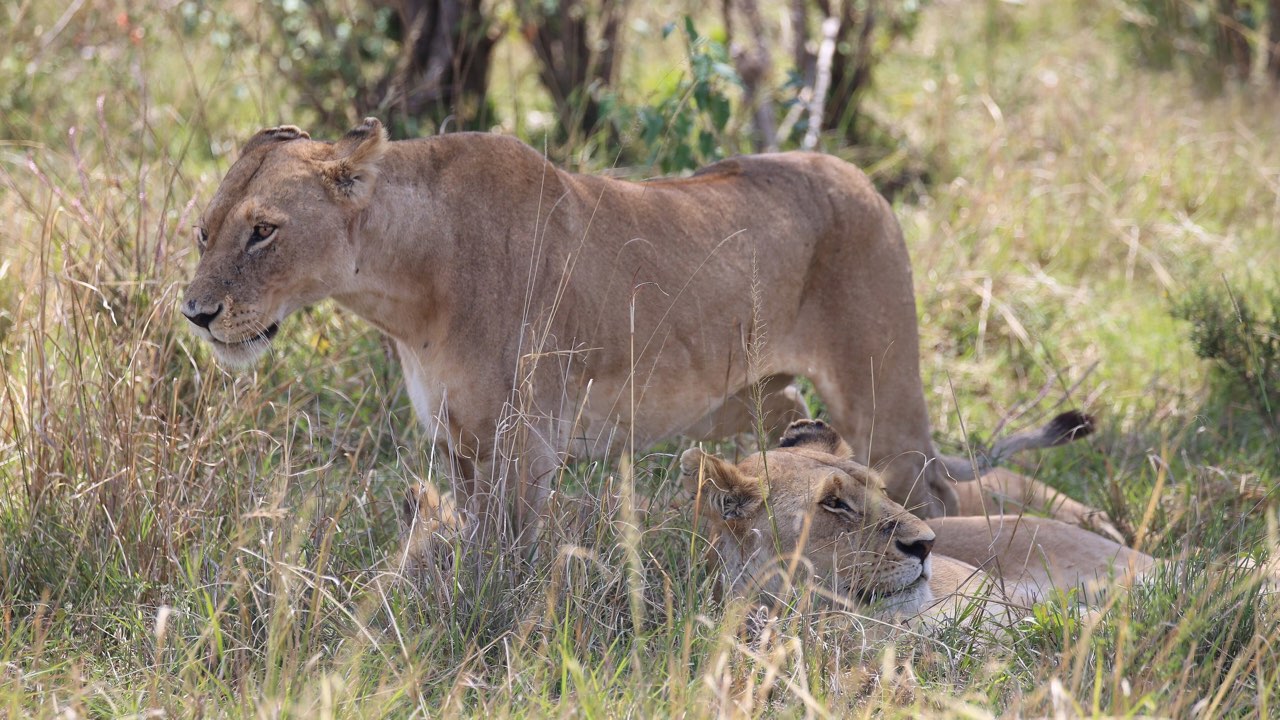
The Kenya Wildlife Trust's Mara Predator Conservation Programme photographs and identifies lions across its Greater Mara study area of about 3,000 km² (1,158 sq mi), reserve and conservancies together. Its survey from 1 August to 31 October 2025 identified 334 unique lions over 1 year old, 102 male and 232 female, against 326 in 2024 (annual report 2025).
That is the study area, not the whole ecosystem. An earlier survey put the density at 17.08 lions over 1 year old per 100 km², with 2.2 females per male, across the reserve and the surrounding conservancies (Elliot and Gopalaswamy, 2017). For scale, the Kenya Wildlife Service counted 2,512 lions in the whole of Kenya in its 2025 census, against 2,589 in 2021 (KWS).
The study found fewer lions where tourist camps were densest. The Trust's peer-reviewed study of lion monitoring data from 2014 to 2022 found lion density substantially lower in areas with high tourist camp density. The camps page shows where camps sit.
334Lions over 1 year old identified, Greater Mara, 2025 (Kenya Wildlife Trust)
17.08Lions per 100 km², reserve and conservancies (2017 study)


16Estimated resident adult cheetahs, Greater Mara, 2025 (Kenya Wildlife Trust)


DumaCheetahs
Cheetahs: few, and sensitive to crowds
Cheetahs are far scarcer than lions. The same 2025 survey identified 21 unique adult cheetahs (12 male, 9 female) and an estimated resident population of 16; in 2024 the figures were 13 and 12. A 2014 study over about 2,398 km² (926 sq mi) of reserve and conservancies estimated 1.28 to 1.34 adult cheetahs per 100 km² (Broekhuis and Gopalaswamy, 2016).
Crowding costs them cubs. In data from 2013 to 2017, females exposed to high tourist numbers raised 0.21 cubs to independence on average, against 2.32 in low-tourism areas. A 2018 study put high-season visitors at about 2,700 a day and noted that the reserve did not limit daily numbers. The study recommends tourist quotas in busy areas and enforced viewing rules on vehicle numbers, behavior, time and distance (Broekhuis, 2018).
The rules exist. The reserve's management plan allows at most five vehicles at a lion, rhino, leopard or cheetah sighting; others wait at least 100 m (328 ft) back, and a vehicle moves on after 15 minutes when others are waiting. In the Triangle's low-use zone, vehicles may leave the road only for big cats, to within 25 m (82 ft), and return the way they came. The reserve page has the full rule set.


Photo: Sumeet Moghe / Wikimedia Commons, CC BY-SA 4.0

ChuiLeopards
Leopards live in the Mara too, and fall under the same sighting rule as lions and cheetahs.
ChuiLeopards, hyenas and the rest
Leopards, hyenas and crocodiles
Leopards, spotted hyenas and Nile crocodiles all live in the Mara. Leopards come under the same sighting rule as lions and cheetahs: a handful of vehicles at a time, for a limited time, at a distance.
Crocodiles turn up in the river studies. Researchers who counted drowned animals at Mara River crossings found fewer than five zebra carcasses in all their surveys, although zebra often fall prey to crocodiles at the crossings (Subalusky and others, 2017). How the crossings work belongs on the migration page.
Smaller lists exist too. The Mara Conservancy publishes a checklist of reptiles and amphibians seen in the Triangle, from the leopard tortoise to the helmeted terrapin and several geckos (reptile list).


A leopard on a grassy mound above the plains, August 2016. Leopards fall under the same five-vehicle sighting rule as lions and cheetahs.
TemboElephants, rhinos and hippos
Elephants, rhinos and hippos
Elephants
KWRTI's 2021 census counted 2,595 elephants in the ecosystem. The Mara Elephant Project rounds that to about 2,600 elephants that call the Mara home, almost half of them identified in its ElephantBook database (MEP). The 2024 count was 2,702, up 4%, one of the few species that grew. The Mara Conservancy notes elephants have increased 2.34% a year since 1984.
The threats have shifted. Poaching killed 96 elephants for their ivory in the Mara in 2012, by the Mara Elephant Project's count. Now the project's conflict incidents have risen from 84 in 2016 to 452 in 2025, and elephant deaths from conflict outpace those from poaching (MEP on conflict). The Mau Forest heads the Mara River's watershed, and the project quotes that the river almost stopped flowing in 2019.


FaruBlack rhino
Black rhinos
The Mara Conservancy puts the black rhinos of the whole Masai Mara at between 25 and 30, with upwards of ten resident in the Triangle, on an undated page. It calls the reserve the only protected area in Kenya with an indigenous black rhino population unaffected by translocations (black rhino page).
The low was steep. The reserve had about 120 black rhinos in 1971 and 18 by 1984, because of poaching. In 2001 one rhino was known in the Triangle; a male moved in in 2002. In 2026 the Mara Elephant Project reported that a female who has given birth to more than 10 calves in the Triangle was treated for a skin worm infection.
So the big five (lion, leopard, elephant, buffalo, rhino) all live in the Mara, with the rhinos the rarest by far.
KibokoHippos
Hippos
The Mara Conservancy reported in 2012, from Mara River research by Dutton and Subalusky, that over 4,100 hippo live in the middle reaches of the Mara River (September 2012 report). Aerial censuses miss hippos that are in the water.


Hippos on a sandbar of the Mara River.
Nyumbu2021 to 2024
Fewer of almost everything since 2021
Kenya's National Wildlife Census 2025 flew the Mara again in 2024. Across the species in the Mara Conservancy's table, the total fell from 119,371 in 2021 to 88,856 in 2024, a 25.6% decline in three years (January 2026 report). Impala were down 42%, topi down 44%, Grant's gazelle down 56%. Only elephants and kongoni went up.
One antelope may return: a roan antelope seen near Ol Kiombo in June 2013 was the first in the Mara since the 1990s, and the Mara Conservancy's June 2026 report says KWS officers were happy with the proposed roan paddocks at Partikilat, with the first two or three males possibly coming from Ruma.
The long view is harsher. Wildlife in Kenya's rangelands fell on average 68% between 1977 and 2016, and about 30% of Kenya's wildlife lived in Narok County alone (Ogutu and others, 2016). The plains are shared: the 2021 census estimated 186,290 cattle and 344,381 sheep and goats in the ecosystem, mostly in the dispersal area.
Why the wildebeest number looks small
The census counts the animals present on the day of the flight. The Mara Conservancy estimated the reserve's resident, non-migrating wildebeest at around 600, with hardly any in the Triangle. The zebra that come a few days ahead of the migration are a separate population that moves between the Loita plains and the reserve. The migrating herd is counted in Tanzania: 1,366,109 (Tanzania Wildlife Research Institute aerial survey, March 2023). In the Mara Conservancy's record for 2001 to 2026, large herds were recorded in the Mara in August in 26 of 26 seasons; the migration page gives every month, and Masai Mara vs Serengeti sets the two parks' counts side by side.
KWS National Wildlife Census 2025, as tabled by the Mara Conservancy.


more than 470Bird species recorded in the reserve (Mara Conservancy)
NdegeBirds
Birds: the longest list
The Mara Conservancy lists more than 470 bird species recorded inside the reserve (bird list). Kenya's 2010 UNESCO entry says more than 500, including 12 cisticolas, 53 birds of prey and a single shoebill record from Musiara Swamp (UNESCO).
BirdLife International lists the Masai Mara Important Bird Area, the reserve plus its dispersal areas, at 5,712.96 km² (2,206 sq mi). Its eight qualifying species include the Lesser Kestrel (Vulnerable, on migration), the Madagascar Pond-heron (Endangered), the Corncrake (Vulnerable), Jackson's Widowbird and the Rufous-tailed Weaver. Its 2024 monitoring rates the site's state near favorable and the pressure very high, from nomadic livestock grazing, persecution and garbage (BirdLife factsheet).
A balloon flight shows the plains from above at dawn.
MaswaliAnimal questions
Masai Mara animal questions
For the months, see the best time to visit. For a trip that covers the reserve and a conservancy, see Masai Mara safaris and what a safari costs.
How many lions are in the Masai Mara?
The counts cover study areas, not the whole ecosystem. The Kenya Wildlife Trust identified 334 lions over 1 year old in its Greater Mara study area in 2025, against 326 in 2024. A 2017 study estimated 17.08 lions over 1 year old per 100 km² across the reserve and the surrounding conservancies. Kenya as a whole had 2,512 lions in the 2025 national census.
Is there a tiger in the Masai Mara?
No. Tigers live in Asia, not in Africa. The Mara's big cats are lions, leopards and cheetahs. The Kenya Wildlife Trust estimated 16 resident adult cheetahs in the Greater Mara in 2025.
Are the big five in the Masai Mara?
Yes, all five live there: lion, leopard, elephant, buffalo and black rhino. The rhino is the rare one. The Mara Conservancy puts the whole Masai Mara's black rhinos at between 25 and 30, upwards of ten of them resident in the Triangle. Buffalo are the reserve's most counted large animal: 5,236 in its main block in 2021, out of 11,604 in the whole ecosystem.
Where in the Mara are most animals?
It depends on the animal. In the 2021 census, buffalo, topi and elephants were mostly inside the reserve and the Triangle, while zebra, wildebeest, gazelles and giraffe were mostly outside, on conservancy and community land. Only 1% of the zebra stood inside the two protected blocks on the day of the count, against 71% of the buffalo.
How many elephants are in the Masai Mara?
KWRTI's 2021 aerial census counted 2,595 elephants in the Mara ecosystem, and the 2024 count was 2,702. The Mara Elephant Project puts the number that call the Mara home at about 2,600, almost half of them identified in its ElephantBook database. On the day of the 2021 count, the Triangle block held more elephants than the reserve's main block.
Safari njemaBefore you go
Where to go from here
For lions, buffalo and topi on open plains, the reserve and the Triangle hold the counts. For zebra, gazelles and giraffe, and for walks or night drives where a conservancy's own rules allow them, look at the conservancies next door. Where to stay lines up the areas, and the national reserve page has the rules for a sighting. A reserve ticket runs to a fixed hour whatever time you enter; the entrance fee page explains the window and counts the ticket days a stay needs.
Sources
- Subalusky et al. 2017: fewer than five zebra carcasses were counted in all their drowning surveys, although zebra often fall prey to crocodiles at Mara River crossings. Subalusky, Dutton, Rosi & Post 2017, PNAS 114(29): Annual mass drownings of the Serengeti wildebeest migration influence nutrient cycling and storage in the Mara River (open-access full text on PubMed Central).
- The reserve management plan visitor rules allow at most five vehicles around lions, rhinos, leopards and cheetahs; others must wait at least 100 meters away and vehicles must move on after 15 minutes when others are waiting. Narok County: Maasai Mara National Reserve Management Plan 2023-2032 (Final, February 2023).
- In the Mara Triangle's Low Use Zone, vehicles may leave the road only to approach big cats (lion, leopard, cheetah), to within 25 meters, and must return to the road by the route they came. Mara Conservancy: Driving to the Mara Triangle.
- Kenya's 2010 UNESCO tentative-list entry states more than 500 bird species are known from the Maasai Mara, including 12 cisticola species and 53 birds of prey, with a single shoebill record from Musiara Swamp. UNESCO World Heritage Centre: Tentative Lists, The African Great Rift Valley - The Maasai Mara (Ref. 5512), 2010-02-12.
- The Kenya Wildlife Service states that the 2025 National Wildlife Census counted 2,512 lions in Kenya, a slight decline from 2,589 in 2021 (national totals, not Mara-only). Kenya Wildlife Service: 'Celebrating The Monarch and His Fragile Kingdom on World Lion Day' (news), 2026-08-10.
- BirdLife International lists the Masai Mara Important Bird and Biodiversity Area (reserve plus dispersal areas) at 5,712.96 km2, elevation 1,500 to 2,170 m, with 8 qualifying bird species, 25.3% covered by protected areas and OECMs, partner NatureKenya. BirdLife International DataZone: Site factsheet Masai Mara.
- BirdLife International's qualifying birds for the Masai Mara IBA are Red-throated Tit, Usambiro Barbet, Lesser Kestrel (Vulnerable, on migration), Madagascar Pond-heron (Endangered, non-breeding), Corncrake (Vulnerable, non-breeding), Grey-crested Helmet-shrike, Jackson's Widowbird and Rufous-tailed Weaver. BirdLife International DataZone: Site factsheet Masai Mara.
- BirdLife International's 2024 monitoring rates the Masai Mara IBA's state as near favourable, pressure as very high (very high threats: nomadic livestock grazing, persecution, garbage and solid waste) and conservation response as high. BirdLife International DataZone: Site factsheet Masai Mara, Monitoring.
- KWRTI aerial census 2021 of the Maasai Mara ecosystem (12,504 km2): Wildebeest counted 156 in the main reserve (MMNR block, 1,048 km2), none listed in the Mara Triangle (477 km2), 37,281 in the whole ecosystem (reserve, conservancies, dispersal area, Nyakweri). Mara Conservancy monthly report June 2023, table image of KWRTI Aerial Census of Large Mammals in Maasai Mara Ecosystem (2021), 2023-07-02.
- KWRTI aerial census 2021 of the Maasai Mara ecosystem (12,504 km2): Zebra counted 239 in the main reserve (MMNR block, 1,048 km2), 194 in the Mara Triangle (477 km2), 32,358 in the whole ecosystem (reserve, conservancies, dispersal area, Nyakweri). Mara Conservancy monthly report June 2023, table image of KWRTI Aerial Census of Large Mammals in Maasai Mara Ecosystem (2021), 2023-07-02.
- KWRTI aerial census 2021 of the Maasai Mara ecosystem (12,504 km2): Buffalo counted 5236 in the main reserve (MMNR block, 1,048 km2), 2954 in the Mara Triangle (477 km2), 11,604 in the whole ecosystem (reserve, conservancies, dispersal area, Nyakweri). Mara Conservancy monthly report June 2023, table image of KWRTI Aerial Census of Large Mammals in Maasai Mara Ecosystem (2021), 2023-07-02.
- KWRTI aerial census 2021 of the Maasai Mara ecosystem (12,504 km2): Impala counted 1675 in the main reserve (MMNR block, 1,048 km2), 817 in the Mara Triangle (477 km2), 10,610 in the whole ecosystem (reserve, conservancies, dispersal area, Nyakweri). Mara Conservancy monthly report June 2023, table image of KWRTI Aerial Census of Large Mammals in Maasai Mara Ecosystem (2021), 2023-07-02.
- KWRTI aerial census 2021 of the Maasai Mara ecosystem (12,504 km2): Thomson's gazelle counted 630 in the main reserve (MMNR block, 1,048 km2), 207 in the Mara Triangle (477 km2), 8278 in the whole ecosystem (reserve, conservancies, dispersal area, Nyakweri). Mara Conservancy monthly report June 2023, table image of KWRTI Aerial Census of Large Mammals in Maasai Mara Ecosystem (2021), 2023-07-02.
- KWRTI aerial census 2021 of the Maasai Mara ecosystem (12,504 km2): Topi counted 3782 in the main reserve (MMNR block, 1,048 km2), 749 in the Mara Triangle (477 km2), 6923 in the whole ecosystem (reserve, conservancies, dispersal area, Nyakweri). Mara Conservancy monthly report June 2023, table image of KWRTI Aerial Census of Large Mammals in Maasai Mara Ecosystem (2021), 2023-07-02.
- KWRTI aerial census 2021 of the Maasai Mara ecosystem (12,504 km2): Grant's gazelle counted 305 in the main reserve (MMNR block, 1,048 km2), 40 in the Mara Triangle (477 km2), 3893 in the whole ecosystem (reserve, conservancies, dispersal area, Nyakweri). Mara Conservancy monthly report June 2023, table image of KWRTI Aerial Census of Large Mammals in Maasai Mara Ecosystem (2021), 2023-07-02.
- KWRTI aerial census 2021 of the Maasai Mara ecosystem (12,504 km2): Elephant counted 668 in the main reserve (MMNR block, 1,048 km2), 816 in the Mara Triangle (477 km2), 2595 in the whole ecosystem (reserve, conservancies, dispersal area, Nyakweri). Mara Conservancy monthly report June 2023, table image of KWRTI Aerial Census of Large Mammals in Maasai Mara Ecosystem (2021), 2023-07-02.
- KWRTI aerial census 2021 of the Maasai Mara ecosystem (12,504 km2): Giraffe counted 160 in the main reserve (MMNR block, 1,048 km2), 141 in the Mara Triangle (477 km2), 2109 in the whole ecosystem (reserve, conservancies, dispersal area, Nyakweri). Mara Conservancy monthly report June 2023, table image of KWRTI Aerial Census of Large Mammals in Maasai Mara Ecosystem (2021), 2023-07-02.
- KWRTI aerial census 2021 of the Maasai Mara ecosystem (12,504 km2): Eland counted 19 in the main reserve (MMNR block, 1,048 km2), 77 in the Mara Triangle (477 km2), 1280 in the whole ecosystem (reserve, conservancies, dispersal area, Nyakweri). Mara Conservancy monthly report June 2023, table image of KWRTI Aerial Census of Large Mammals in Maasai Mara Ecosystem (2021), 2023-07-02.
- KWRTI aerial census 2021 of the Maasai Mara ecosystem (12,504 km2): Kongoni counted 167 in the main reserve (MMNR block, 1,048 km2), 1 in the Mara Triangle (477 km2), 764 in the whole ecosystem (reserve, conservancies, dispersal area, Nyakweri). Mara Conservancy monthly report June 2023, table image of KWRTI Aerial Census of Large Mammals in Maasai Mara Ecosystem (2021), 2023-07-02.
- KWRTI aerial census 2021 of the Maasai Mara ecosystem (12,504 km2): Warthog counted 89 in the main reserve (MMNR block, 1,048 km2), 53 in the Mara Triangle (477 km2), 574 in the whole ecosystem (reserve, conservancies, dispersal area, Nyakweri). Mara Conservancy monthly report June 2023, table image of KWRTI Aerial Census of Large Mammals in Maasai Mara Ecosystem (2021), 2023-07-02.
- KWRTI aerial census 2021 of the Maasai Mara ecosystem (12,504 km2): Waterbuck counted 34 in the main reserve (MMNR block, 1,048 km2), 24 in the Mara Triangle (477 km2), 161 in the whole ecosystem (reserve, conservancies, dispersal area, Nyakweri). Mara Conservancy monthly report June 2023, table image of KWRTI Aerial Census of Large Mammals in Maasai Mara Ecosystem (2021), 2023-07-02.
- KWRTI aerial census 2021 of the Maasai Mara ecosystem (12,504 km2): Ostrich counted 75 in the main reserve (MMNR block, 1,048 km2), 34 in the Mara Triangle (477 km2), 215 in the whole ecosystem (reserve, conservancies, dispersal area, Nyakweri). Mara Conservancy monthly report June 2023, table image of KWRTI Aerial Census of Large Mammals in Maasai Mara Ecosystem (2021), 2023-07-02.
- KWRTI aerial census 2021 block areas: Maasai Mara National Reserve main block 1,048 km2, Mara Triangle 477 km2, conservancies (MMWCA) 1,832 km2, dispersal area 8,603 km2, Nyakweri 544 km2, total 12,504 km2. Mara Conservancy monthly report June 2023, table image of KWRTI Aerial Census of Large Mammals in Maasai Mara Ecosystem (2021), 2023-07-02.
- Mara Conservancy (June 2023), from the KWRTI 2021 census: elephant have increased 2.34% a year since 1984 and buffalo about 7% a year in the Mara ecosystem. Mara Conservancy: monthly report June 2023, 2023-07-02.
- KWRTI 2021 census as reported by the Mara Conservancy: an estimated 186,290 cattle and 344,381 sheep and goats in the Mara ecosystem, mostly in the dispersal area. Mara Conservancy: monthly report June 2023, 2023-07-02.
- Kenya Wildlife Service National Wildlife Census 2025, Mara ecosystem, as tabled by the Mara Conservancy: Common zebra 32,358 in 2021 and 29,195 in 2024. Mara Conservancy monthly report January 2026, table image sourced to Kenya Wildlife Service: National Wildlife Census 2025 (Mara ecosystem 2021 vs 2024), 2026-02-02.
- Kenya Wildlife Service National Wildlife Census 2025, Mara ecosystem, as tabled by the Mara Conservancy: Wildebeest 37,281 in 2021 and 26,878 in 2024. Mara Conservancy monthly report January 2026, table image sourced to Kenya Wildlife Service: National Wildlife Census 2025 (Mara ecosystem 2021 vs 2024), 2026-02-02.
- Kenya Wildlife Service National Wildlife Census 2025, Mara ecosystem, as tabled by the Mara Conservancy: African buffalo 11,604 in 2021 and 8878 in 2024. Mara Conservancy monthly report January 2026, table image sourced to Kenya Wildlife Service: National Wildlife Census 2025 (Mara ecosystem 2021 vs 2024), 2026-02-02.
- Kenya Wildlife Service National Wildlife Census 2025, Mara ecosystem, as tabled by the Mara Conservancy: Impala 10,610 in 2021 and 6101 in 2024. Mara Conservancy monthly report January 2026, table image sourced to Kenya Wildlife Service: National Wildlife Census 2025 (Mara ecosystem 2021 vs 2024), 2026-02-02.
- Kenya Wildlife Service National Wildlife Census 2025, Mara ecosystem, as tabled by the Mara Conservancy: Thomson's gazelle 8278 in 2021 and 5162 in 2024. Mara Conservancy monthly report January 2026, table image sourced to Kenya Wildlife Service: National Wildlife Census 2025 (Mara ecosystem 2021 vs 2024), 2026-02-02.
- Kenya Wildlife Service National Wildlife Census 2025, Mara ecosystem, as tabled by the Mara Conservancy: Topi 6923 in 2021 and 3908 in 2024. Mara Conservancy monthly report January 2026, table image sourced to Kenya Wildlife Service: National Wildlife Census 2025 (Mara ecosystem 2021 vs 2024), 2026-02-02.
- Kenya Wildlife Service National Wildlife Census 2025, Mara ecosystem, as tabled by the Mara Conservancy: African elephant 2595 in 2021 and 2702 in 2024. Mara Conservancy monthly report January 2026, table image sourced to Kenya Wildlife Service: National Wildlife Census 2025 (Mara ecosystem 2021 vs 2024), 2026-02-02.
- Kenya Wildlife Service National Wildlife Census 2025, Mara ecosystem, as tabled by the Mara Conservancy: Eland 1280 in 2021 and 1012 in 2024. Mara Conservancy monthly report January 2026, table image sourced to Kenya Wildlife Service: National Wildlife Census 2025 (Mara ecosystem 2021 vs 2024), 2026-02-02.
- Kenya Wildlife Service National Wildlife Census 2025, Mara ecosystem, as tabled by the Mara Conservancy: Grant's gazelle 3893 in 2021 and 1724 in 2024. Mara Conservancy monthly report January 2026, table image sourced to Kenya Wildlife Service: National Wildlife Census 2025 (Mara ecosystem 2021 vs 2024), 2026-02-02.
- Kenya Wildlife Service National Wildlife Census 2025, Mara ecosystem, as tabled by the Mara Conservancy: Masai giraffe 2109 in 2021 and 1611 in 2024. Mara Conservancy monthly report January 2026, table image sourced to Kenya Wildlife Service: National Wildlife Census 2025 (Mara ecosystem 2021 vs 2024), 2026-02-02.
- Kenya Wildlife Service National Wildlife Census 2025, Mara ecosystem, as tabled by the Mara Conservancy: Hartebeest 764 in 2021 and 877 in 2024. Mara Conservancy monthly report January 2026, table image sourced to Kenya Wildlife Service: National Wildlife Census 2025 (Mara ecosystem 2021 vs 2024), 2026-02-02.
- Kenya Wildlife Service National Wildlife Census 2025, Mara ecosystem, as tabled by the Mara Conservancy: Warthog 574 in 2021 and 477 in 2024. Mara Conservancy monthly report January 2026, table image sourced to Kenya Wildlife Service: National Wildlife Census 2025 (Mara ecosystem 2021 vs 2024), 2026-02-02.
- Kenya Wildlife Service National Wildlife Census 2025, Mara ecosystem, as tabled by the Mara Conservancy: Baboon 162 in 2021 and 136 in 2024. Mara Conservancy monthly report January 2026, table image sourced to Kenya Wildlife Service: National Wildlife Census 2025 (Mara ecosystem 2021 vs 2024), 2026-02-02.
- Kenya Wildlife Service National Wildlife Census 2025, Mara ecosystem, as tabled by the Mara Conservancy: Ostrich 215 in 2021 and 120 in 2024. Mara Conservancy monthly report January 2026, table image sourced to Kenya Wildlife Service: National Wildlife Census 2025 (Mara ecosystem 2021 vs 2024), 2026-02-02.
- Kenya Wildlife Service National Wildlife Census 2025, Mara ecosystem, as tabled by the Mara Conservancy: Waterbuck 161 in 2021 and 64 in 2024. Mara Conservancy monthly report January 2026, table image sourced to Kenya Wildlife Service: National Wildlife Census 2025 (Mara ecosystem 2021 vs 2024), 2026-02-02.
- Kenya Wildlife Service National Wildlife Census 2025, Mara ecosystem, as tabled by the Mara Conservancy: Lesser kudu 30 in 2021 and 5 in 2024. Mara Conservancy monthly report January 2026, table image sourced to Kenya Wildlife Service: National Wildlife Census 2025 (Mara ecosystem 2021 vs 2024), 2026-02-02.
- Mara ecosystem large-mammal total fell from 119,371 (2021) to 88,856 (2024), a 25.6% decline, per the Mara Conservancy table sourced to the KWS National Wildlife Census 2025. Mara Conservancy monthly report January 2026, table image sourced to Kenya Wildlife Service: National Wildlife Census 2025 (Mara ecosystem 2021 vs 2024), 2026-02-02.
- KWT Mara Predator Conservation Programme survey August-October 2025: 21 unique adult cheetahs (12 male, 9 female) and an estimated resident cheetah population of 16 (9 male, 7 female) in the Greater Mara study area; 2024: 13 unique adults, 12 estimated resident. Kenya Wildlife Trust (Mara Predator Conservation Programme): Annual Report 2025, 2026-06-17.
- Broekhuis & Gopalaswamy 2016: adult cheetah density in the Maasai Mara estimated at 1.28 ± 0.315 to 1.34 ± 0.337 individuals per 100 km2 (survey 1 August to 31 October 2014, ~2,398 km2 study area of reserve and conservancies). Broekhuis & Gopalaswamy 2016, PLOS ONE 11(5) e0153875: Counting Cats: Spatially Explicit Population Estimates of Cheetah, 2016-05-02.
- Broekhuis 2018: in the Maasai Mara (data 2013-2017), female cheetahs raised on average 1.71 ± 1.35 cubs per litter to independence; females exposed to high tourist abundance raised 0.21 ± 0.72 cubs versus 2.32 ± 0.11 in low-tourism areas. Broekhuis 2018, Ecology and Evolution 8: Natural and anthropogenic drivers of cub recruitment in a large carnivore (open-access full text on PubMed Central).
- Broekhuis 2018 recommends tourist quotas in high-visitation areas and enforced viewing guidelines (number of vehicles, behaviour, time spent, distance to a sighting). Broekhuis 2018, Ecology and Evolution 8: Natural and anthropogenic drivers of cub recruitment in a large carnivore (open-access full text on PubMed Central).
- Broekhuis 2018: during the high season about 2,700 people visit the Maasai Mara National Reserve daily (2.7 visitors per km2), and the reserve does not limit daily visitor numbers (citing Narok and Trans-Mara County Councils 2012). Broekhuis 2018, Ecology and Evolution 8: Natural and anthropogenic drivers of cub recruitment in a large carnivore (open-access full text on PubMed Central).
- Mara Elephant Project: about 2,600 elephants call the Mara home, almost half identified in its ElephantBook database. Mara Elephant Project: Monitor.
- Mara Elephant Project: its human-elephant conflict mitigation incidents rose from 84 in 2016 to 452 in 2025; elephant deaths from conflict now outpace those from poaching. Mara Elephant Project: Conflict.
- Mara Elephant Project: the Mau Forest is at the head of the Mara River watershed; MEP quotes that the Mara River almost stopped flowing in 2019. Mara Elephant Project: Habitat loss.
- Mara Conservancy reports that the Triangle becomes a refuge for elephant herds in the wet season (herds of over 120 to 150 recorded in Dec 2015 and Jan 2016) and they disperse in the dry season. Mara Conservancy: monthly report December 2015.
- The Mara Conservancy publishes a checklist of reptile and amphibian species seen in the Mara Triangle (leopard tortoise, helmeted terrapin, geckos and others). Mara Conservancy: Reptile and Amphibian List.
- Elliot & Gopalaswamy 2017: lion density in the Maasai Mara National Reserve and surrounding conservancies estimated at 17.08 (posterior SD 1.310) lions over 1 year old per 100 km2, sex ratio 2.2 females per male (3-month survey, spatial capture-recapture). Elliot & Gopalaswamy 2017, Conservation Biology 31(4): Toward accurate and precise estimates of lion density (abstract on PubMed), 2017-05-29.
- Kenya Wildlife Trust Mara Predator Conservation Programme survey 1 August to 31 October 2025 over its ~3,000 km2 Greater Mara study area: 334 unique lions over 1 year old (102 male, 232 female), 316 lion sightings, 9,206 km driven; 2024: 326 lions (121 male, 205 female). Kenya Wildlife Trust (Mara Predator Conservation Programme): Annual Report 2025, 2026-06-17.
- KWT annual report 2025: the Mara Predator Conservation Programme published a peer-reviewed study using lion monitoring data from 2014 to 2022, which found lion density is substantially lower in areas with high tourist camp density. Kenya Wildlife Trust (Mara Predator Conservation Programme): Annual Report 2025, 2026-06-17.
- Mara Conservancy (Sept 2012), from Mara River research by Dutton and Subalusky: over 4,100 hippo live in the middle reaches of the Mara River. Mara Conservancy: monthly report September 2012.
- Mara Conservancy (June 2013): a roan antelope seen near Ol Kiombo was the first roan in the Mara since the 1990s; in its June 2026 report the Mara Conservancy states KWS officers who visited the proposed roan paddocks at Partikilat were happy with them and said the first two or three males may come from Ruma in July. Mara Conservancy: monthly report June 2013.
- Mara Conservancy (Oct 2009): the resident wildebeest population within the reserve is estimated at around 600 animals, with hardly any in the Triangle. Mara Conservancy: monthly report October 2009.
- Mara Conservancy (July 2018): the zebra that traditionally come a few days before the main migration are a different population from the Serengeti migration; they move between the Loita plains and the reserve and are increasingly constrained to the conservancies around it. Mara Conservancy: monthly report July 2018.
- Mara Conservancy: the Maasai Mara Game Reserve had about 120 black rhinos in 1971 and 18 by 1984 because of poaching. Mara Conservancy: Black Rhino page.
- Mara Conservancy: the Mara Triangle's resident black rhino population is upwards of ten, while the whole Maasai Mara population hovers between 25 and 30 (undated page). Mara Conservancy: Black Rhino page.
- Mara Conservancy: the Maasai Mara National Reserve is the only protected area in Kenya with an indigenous black rhino population unaffected by translocations. Mara Conservancy: Black Rhino page.
- Mara Conservancy: in 2001 there was one known rhino in the Mara Triangle; a male moved in in 2002. Mara Conservancy: Black Rhino page.
- Mara Elephant Project (Q3 2026): a female black rhino in the Maasai Mara that has given birth to more than 10 calves in the Mara Triangle was treated for a skin worm infection. Mara Elephant Project: Q3 2026 CEO Report.
- Ogutu et al. 2016: wildlife numbers in Kenya's rangelands fell on average by 68% between 1977 and 2016 (DRSRS aerial surveys over 88% of Kenya), and about 30% of Kenya's wildlife occurred in Narok County alone. Ogutu et al. 2016, PLOS ONE 11(9) e0163249: Extreme Wildlife Declines and Concurrent Increase in Livestock Numbers in Kenya, 2016-09-27.
- Census counts by block, 2021 and 2024. KWRTI aerial census 2021 of the Mara ecosystem (block table in the Mara Conservancy report of June 2023) and KWS National Wildlife Census 2025, Mara ecosystem (table in the Mara Conservancy report of January 2026); changes and shares computed from those two tables
- Figures where sources differ. One register row per figure where official sources conflict (data/canon.json names the row, the body and the reason)
- Unit conversions. Metric figures with US equivalents (1 km = 0.621371 mi, 1 m = 3.28084 ft, 1 kg = 2.20462 lb, 1 ft = 0.3048 m, 1 acre = 0.404686 ha, °F = °C × 9/5 + 32)
- Migration records. Mara Conservancy monthly reports (Mara Triangle), seasons 2001 to 2026, audited 12 November 2026: one definition per event (first small groups, first large herds, first Mara River crossing, departure of the large herds), counted by season